

Gender is a construct.
If you’ve spent any time in queer or feminist spaces, you’ve probably heard that phrase. When I first heard it, it rang true—as loud as a steel door clanging shut in a cell.
By my late teens, I was increasingly aware of gender as something that had been constructed around me. Female was a neutral, scientific descriptor of my body that I took no issue with, but woman set my teeth on edge. But I flashed gritted smiles, shaved my legs, was she-ed and her-ed and miss-ed and ma’am-ed, and assumed womanhood was like this for everyone: a subject of indifference at best, a prison at worst.
Being a woman doesn’t really mean anything, right? It’s just something you are, a way that you’re perceived, a set of expectations to follow. Gender is in the eye of the beholder.
Womanhood is like that, for some people. But it doesn’t have to be. Learning about the fascinating, beautiful, and complex ways queer women, particularly trans women and lesbians, approach gender opened my eyes to the possibility of more.
I’m far from the first person to have their understanding of gender expanded by Stone Butch Blues by Leslie Feinberg, and it brings me no end of joy to know I won’t be the last. This enduring, compelling work of queer literature explores lesbian, trans, and non-binary identity in ways that are still revolutionary today.
From the outside looking in, people are often tempted to reduce the lesbian butch/femme dynamic to one partner being “the man” and one being “the woman.” The truth is more complicated. Sometimes, neither lesbian partner is “the woman,” or even a woman. Their identity as a lesbian can feel more significant than their identity as a woman, and that, more than wanting to be seen as a particular gender, can be the driving force behind their presentation, pronouns, etc.
I’m not a lesbian myself, and I won’t pretend to understand the deepest intricacies of a community I’m not a part of. I simply want to highlight the rich complexities gender historically has had within lesbian spaces and how it inspired me to take a closer look at my own experience.
Stone Butch Blues led me to question, and trans women helped me arrive at my answer.
Trans women fight ceaselessly for the right to womanhood. From systemic issues, like concerted political efforts being made to legislate them out of public existence, to the daily drain of never quite knowing where, when, or with whom you’re safe to be yourself, bigotry and vitriol can lurk around every corner. Something a simple as a clothing choice or hairstyle gets politicized, debated, or used as evidence to justify dehumanizing treatment.
As any marginalized person can tell you, it’s an exhausting way to live. But trans women do, because that’s how meaningful womanhood is to them. It’s so intrinsic to who they are, they would rather risk their lives, or even commit suicide1, than live without it.
On the uglier side of the coin, there’s the scathing sect of cisgender women who guard their femininity so jealously, they see any woman not assigned female at birth as intruder/usurper/enemy. These women will gladly align with racists and misogynists in the name of “protecting” themselves.
Some define womanhood by the pain of oppression. For them, identifying as a woman when you weren’t born under the yoke amounts to stolen valor. They watch trans women strive for liberation, and all they can see are their own chains. It’s especially disappointing to see survivors of misogynistic violence prize the sanctity of their pain so deeply, they refuse to look beyond it and recognize the suffering of their trans sisters.
Womanhood, my idle inheritance, is a matter of life and death. How can I brush it off as something no one really cares about when, for better or worse, it clearly holds so much significance for others?
I don’t consider myself a woman. I am biologically female, and I was raised with the corresponding set of gendered expectations, many of which I still adhere to. I look feminine and don’t particularly intend to change this. I don’t want to be a man. So what do I want?
Liberation.
I don’t want to live my life under values and expectations imposed by another. I don’t want to keep my head down and let people assume whatever is easiest based on my looks. I want to distance myself from a concept that I find meaningless but is used as shorthand by others to define me. I want to honor womanhood by leaving it to those who claim it wholeheartedly and fiercely.
Gender is a construct, and I want to be the architect of myself.
Maybe it’s a shout in the void, identifying as agender, using they/them pronouns, and going by Solaris when I can. So what? I’ll keep shouting. I’d rather try and fail than silently suffocate.
Part of that trying—and possibly failing—is done through my writing.
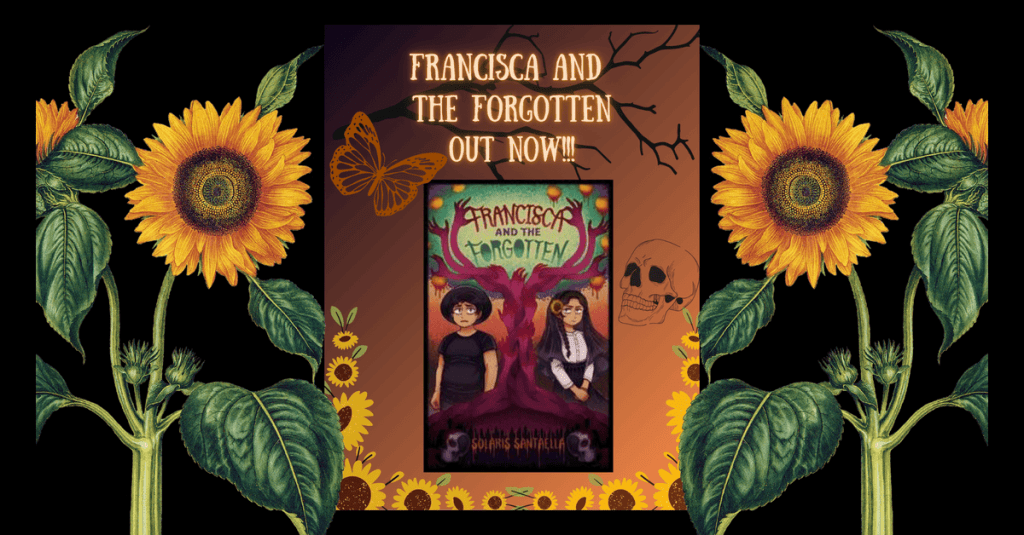
My debut novel, Francisca and the Forgotten, centers a teenage girl trapped in a liminal realm between life and death, who must confront repressed memories to escape. This girl, Francisca, happens to be a trans lesbian: a feisty baby butch.
For some people, a trans protagonist in a YA novel is controversial enough, and others—even some within the LGBT community—would draw the line at a trans girl who wants to be butch.
If you want to be a girl so badly, the implication goes, shouldn’t you try to be the right kind of girl?
I don’t think there is a right way to a girl, to be a lesbian, to be trans, non-binary, or anything else. I don’t think there’s any way you can be, live, or present yourself that merits the dehumanization faced by members of the LGBT community and other marginalized people.
My short story (and second novel-in-progress!) “Lemon Squares in All Dimensions” also interrogates gender. SARA, the robot protagonist, reckons with a gender that was literally constructed—and by a man, at that. Her murderous misogyny is not at odds with her strident defense/valorization of her own womanhood, but, rather, a tragic and inevitable consequence.
These are the kind of stories I want to write and the kinds of people I want to support. If you feel like you’ve been shouting into the void, know that I’m right here, shouting with you.
***
It might be Pride Month, but I will say, I’m not particularly proud of how I’ve neglected this site/my YouTube channel!
I posted “Keeping Up Appearances”, a queer sci-fi/romance short story about a middle-aged, nine-times-divorced shapeshifter trying and failing to hook his best friend up with one of his ex wives, earlier today. Losers deserve representation, too.2
I originally wrote it hoping to make it into the Chaotic Cupids anthology being put out by my alma mater, Western Colorado University, this year, but no dice. However, you’ll be able to buy it here when the time comes, and definitely check out the story by JL Smyser, my friend and publisher. I was lucky enough to offer some edits early on, and, not to pat myself on the back too much, but I think they really helped.3
I don’t want to make any grand, sweeping promises, but I do intend to get back into doing “Constellations” every Sunday and book reviews every Wednesday. Also, I have a couple ideas for a Pride Month-themed YouTube video, but I’m not sure which (if either) will actually wind up being made.
Francisca and the Forgotten is pretty much out of my hands now. The final revisions are done, the final copyedits reviewed, the ARCs ready to go forth over land and sea and set fire to the hearts of men with my word.4
Where does that leave me with my original writing? Trying, for the millionth year in a row it feels like, to finish the novelization of Lemon Squares in All Dimensions. Guess I’d better get back in the kitchen…
- Some articles about trans suicide here and here, along with some resources here ↩︎
- The loser call is coming from inside the house. ↩︎
- My spine is poking out through my stomach from the force of how hard I’m patting myself on the back. Josh is a great writer who comes up with really compelling premises, and he’s EXCELLENT at taking feedback. I can’t wait for everyone to see his work. ↩︎
- “The Prophet” by Alexander Pushkin, a poem I fell in love with in high school. The version I was taught ended “Set fire to the hearts of men with your word” instead of “ignite.” I studied it in a Russian summer intensive program I took at UW-Madison the summer before my senior year and liked the last lines so much, I decided to use them as my senior quote. However, due to a yearbook mixup, the girl next to me ended up with my quote and I got hers: “You gotta work hard to ball hard.” Basically my villain origin story. ↩︎

 THE SOLARIUM
Leave a comment