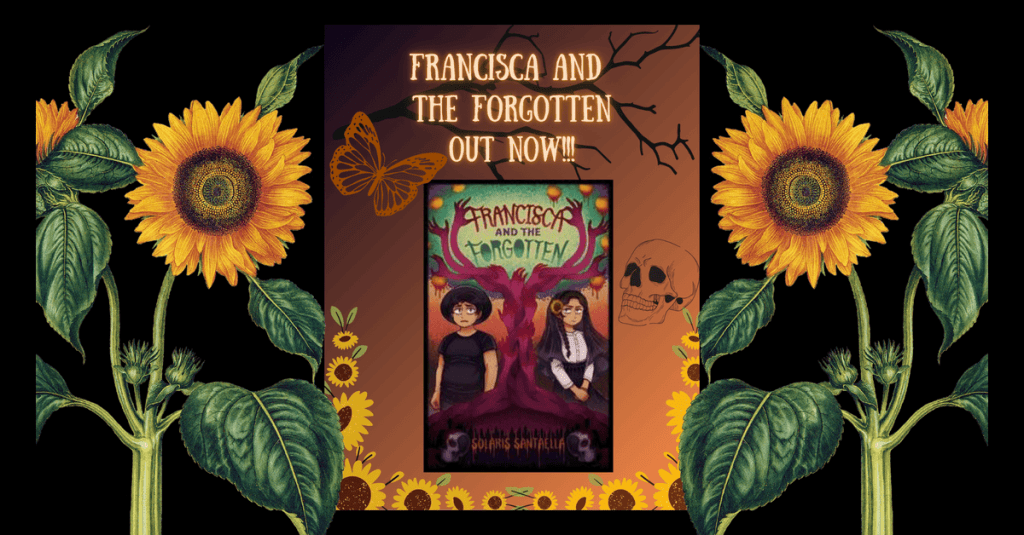
I’m currently hard at work revising my first novel, Francisca and the Forgotten.
My journey with this project has been such a long one, it’s hard to believe that some sort of end is drawing nearer, but, word by word, page by page, I’m getting there. Finishing these revisions, requested by my publishers at Blue Feather Quill, will bring me one step closer to being a published author.
I want to take a moment to reflect on my progress with Francisca and the Forgotten over the years.
When I was younger, I always wanted to write a Dia de los Muertos story. Being Mexican-American, I grew up knowing it was part of my family’s culture, but we never really celebrated it in my household. I don’t think anyone in my dad’s family does. Still, it was something I was aware of and found fascinating.
Judging by the popularity of films like Coco and, to a lesser extent, The Book of Life, Dia de los Muertos is popular with plenty of non-Mexicans, too! However, seeing the holiday receive increased prominence in mainstream American culture has been something of a mixed blessing.
At times, it feels like the only story the US wants from Mexicans are Dia de los Muertos stories. Over the years, the thought of writing one became less a way for me to explore my cultural heritage than merely falling in line with what was expected of me, and I lost interest.
Before then, I came up with, but never really wrote, a Coraline-adjacent story about a girl reuniting with the ghost of her mother in a fantastical afterlife while simultaneously being haunted by a second ghost: the parts of her mother she repressed from memory.
The story grew, eventually including a dead sister as well: Maria Elena. Some characters have a way of grabbing you before you even know why and changing the trajectory of the story. Fleshing out the sister forced me to reconsider and deepen my characterization of the protagonist, Francisca, and also raised the question: would the friendly sister ghost have a cruel counterpart like the mother?
I decided, yes, for every ghost Francisca met–every part of the family she loved–there would be a second self clamoring for acknowledgement. Even still-living Francisca had a ghost: her own repressed darkness.
Developing Francisca Viva and Francisca Muerta eventually led to me realizing I didn’t have two parts of one self but, rather, two distinct characters. This completely threw off my previous plan for the book. This, along with my growing ambivalence toward writing “a Dia de los Muertos story” led me to abandon the project for a time.
In college, I took a number of creative writing workshops, including one in poetry, which was required for my major. I wrote a poem entitled “The Orange Tree We Never Climb” about a haunted orange tree and a girl grieving the loss of her twin sister. The poem had two columns, one representing the living, and one representing the dead.
The poem itself was nothing special, but the orange tree was a striking image, and the tragedy of the two twins got me thinking about Francisca and her lost sister. Before I knew it, I had woven the two into the same world, and I was ready to return to Francisca and the Forgotten.
I made major progress on it for NaNoWriMo one year and finished my first draft in the months that followed.
Perhaps because I was, in a sense, translating from poetry to prose, the first chapter (which you can read here) has a very poetic feel–it’s “ethereal”, as my editor put it.
However, when Francisca and the Forgotten is eventually published, it will not include this chapter at all.
My editor found the pacing in the first half too slow for YA. Do I agree? Maybe. Teenage me was already precociously pretentious and loved literary fiction, where pacing tends to be secondary to the language itself, and I never cared if a chapter started fast and ended with a zinger. But not every reader is like me, and I don’t want to write for an audience of one.
I never make an artistic choice I can’t defend, but over the years, I’ve learned to choose my battles. Will getting rid of the first chapter, the most poetic passage of the book, possibly my favorite, and certainly the one I worked hardest on, fundamentally alter the soul of the book? Will it lose its message?
I don’t think so. Actually, the change hasn’t been devastating at all.
It’s been fun.
It’s fun to be challenged to consider my work from a fresh perspective. It’s fun to imagine all the ways it could be different, better. It’s fun to add more hauntings, more subtlety, more plot.
There are many horrors involved in Francisca and the Forgotten, but, fortunately the revision process has not been one of them.
So far.
Because I’m trying to get these revisions finished before I go on a family trip mid-September, I’m not planning to release a video next month. However, I already have a topic in mind for October, and, believe me, it’s more cursed than any monster you’ll encounter on Halloween.

 THE SOLARIUM
Leave a comment